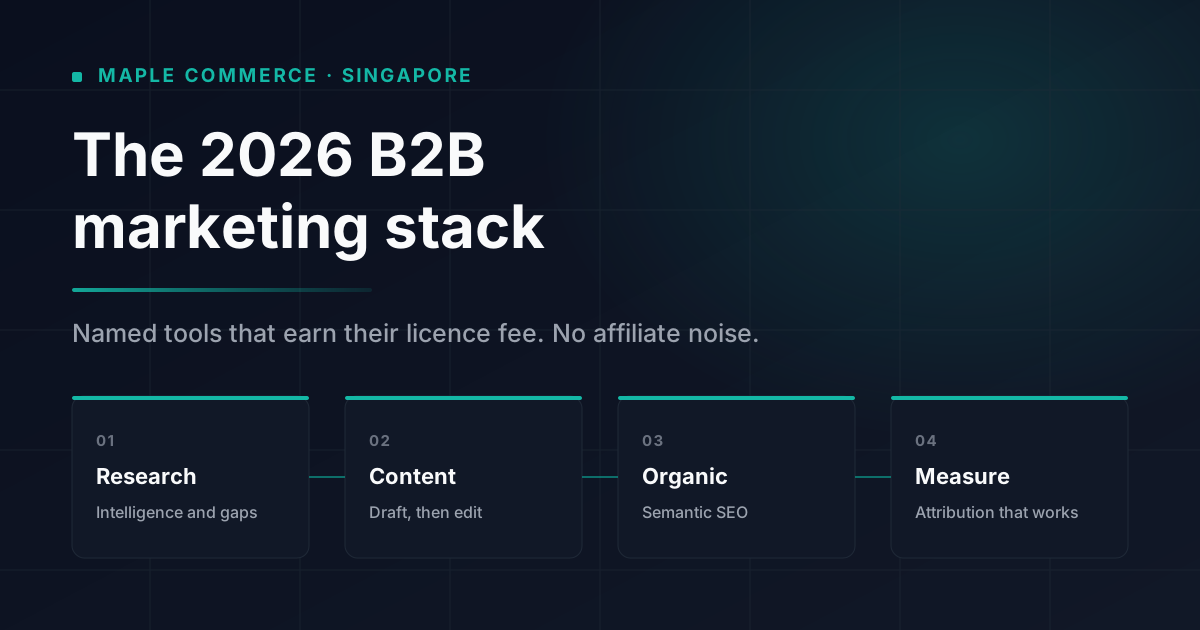
Buy against the jobs your stack has to do, not against tool categories. Most over-tooled Singapore B2B teams are paying for two tools that do the same job while leaving another job entirely uncovered.
The number of AI marketing tools in the average Singapore B2B stack has roughly tripled in 18 months. The number of marketing teams that can tell you what each tool produces, in business terms, has not changed.
I see the same pattern across the founders, CMOs, and L&D leads I work with. Eight tool subscriptions. Three power users. Two tools that drive measurable output. Five tools that someone signed up for during a free trial and nobody has touched since.
This piece is a working B2B stack for 2026, by job to be done. Named tools, real use cases, what the tool actually replaces. If a category is not here, it is because I do not see it earning its place in a B2B Singapore business yet.
What jobs does a B2B marketing stack have to do?
Ignore the category pages on G2 for a moment. A B2B marketing stack only needs to do five things well.
- Research and intelligence. What is the market talking about, what are competitors doing, what are buyers searching for, what is happening in your category.
- Content and creative. Producing, editing, and packaging the things that go out – articles, decks, emails, landing pages, video scripts, social.
- Semantic SEO and organic visibility. Making sure the content is structured to rank in Google and to be cited by AI search.
- Automation and workflow. Connecting tools, moving data, running sequences, freeing up team time from repetitive work.
- Measurement and attribution. Tying activity back to pipeline, MQLs, SQLs, and revenue.
If a tool does not directly support one of those five jobs, it is a candidate for the cull list.
Which tools handle research and intelligence?
Claude (Anthropic) and ChatGPT (OpenAI). Both. Different jobs.
Claude is my default for long-document reasoning – competitor websites, transcripts, sales-call data, regulatory texts. It handles 200,000-token contexts cleanly and gives me the kind of structured analysis I would otherwise pay an analyst to write up.
ChatGPT is my default for quick lookups, web search, and image generation. The deep-research mode is useful for category scans, where I want a 20-page synthesis with citations to read on the train home.
Perplexity. For competitive monitoring and time-sensitive lookups where I need citations on the page. Cheaper than running deep research in ChatGPT for routine work.
Cost: SGD 30–40 a month per seat for each. A team of three will spend under SGD 400 a month and replace several hours a week of manual research.
Which tools handle content and creative?
Claude or ChatGPT for first drafts. I rarely use either to write the final version – the voice is wrong out of the box. They are useful for outlines, fact-checking, structure, and turning bullet points into prose I then edit.
Descript for video editing and AI voiceovers, especially for short product walkthroughs and internal training. The transcript-based editing model is faster than a timeline editor for anything under 10 minutes.
Canva with its AI features for non-designers who need to produce on-brand visuals at speed. Adobe Express is the equivalent for teams already on Creative Cloud.
Notion AI for internal writing – briefs, meeting notes, project docs. It is not where I would write a sales page, but it is where I would draft a campaign brief.
The mistake most teams make in this category is treating AI as a content factory. Volume is not the bottleneck. The bottleneck is having something worth saying. AI helps you say it faster, in more formats. It does not generate the strategic substance.
Which tools handle semantic SEO and organic visibility?
This is the category where Singapore B2B businesses see the highest ROI from AI tooling in 2026, because the SEO landscape has moved toward entity-based, semantic content and away from keyword density.
Ahrefs and Semrush. Either one. Both have integrated AI features for content gap analysis, topical clustering, and SERP intent detection. I use Ahrefs day to day because the data is cleaner for Singapore queries.
Surfer SEO or Clearscope for on-page optimisation. These tools score your draft against the top-ranking pages for your target query and tell you which entities you are missing. Useful if your team writes the content. Less useful if you are still working out the topical strategy.
Schema markup generators. Schema App or Merkle’s free generator for structured data. Most B2B sites in Singapore have weak schema or none at all – fixing that is one of the highest-impact technical SEO moves a founder can make in 2026.
For semantic SEO specifically, the framework matters more than the tool. I use what I call the Semantic Growth Engine™ approach – entity mapping first, content cluster second, technical schema third. Plug any of the tools above into that sequence and the output is consistent.
Which tools handle automation and workflow?
Make (formerly Integromat) and Zapier are the two automation platforms most B2B teams will end up on. Make is more flexible and cheaper for complex workflows. Zapier is faster for simple one-step integrations.
HubSpot if you can afford it, for B2B teams that want a CRM, marketing automation, and content management in one place. The AI features inside HubSpot (Breeze) are useful for lead scoring and content suggestion, less useful for content creation than dedicated tools.
n8n for technical teams that want self-hosted automation. Open-source, more control, steeper setup. I see it most often in companies with an in-house engineer who can babysit the deployment.
The honest answer for most Singapore B2B teams under 50 people: start with Make, add HubSpot when your sales team is ready, and ignore n8n until you have a developer who wants the toy.
Which tools handle measurement and attribution?
GA4 with BigQuery export if you have anyone on the team who can write SQL. The export is free up to 1 million events per day. Once your data is in BigQuery, you can build the attribution model you actually want, instead of the one Google ships.
Plausible or Fathom for teams that do not need GA4 depth but want clean, privacy-friendly analytics that loads in under 100ms. I use Plausible on most of my client sites.
Common Room or HockeyStack for B2B teams that want to track community signals, dark social, and account-level engagement that GA4 cannot see. These are still emerging in Singapore but worth a pilot for any B2B doing serious content distribution on LinkedIn.
Which tools should you cut?
The categories I see Singapore B2B teams over-invest in:
- AI image generators beyond Midjourney or the built-in Canva/Adobe tools. Most B2B brand visuals do not need a SGD 60/month image-generation subscription on top.
- Standalone email copywriting tools that do what Claude or ChatGPT already do better, charging four times the price.
- AI meeting note-takers beyond one. Pick one (Fireflies, Otter, or Granola) and stop layering.
- Social media schedulers with “AI” in the name. Most are repackaged Buffer features with a 3x price tag.
If you are paying for two tools that do roughly the same job, you have a buying-on-impulse problem, not a tooling problem.
What does a working stack look like at three team sizes?
For a Singapore B2B at three different stages:
| Size | Core stack | Monthly tooling cost (SGD) |
|---|---|---|
| Founder + 1 marketer | Claude, ChatGPT, Ahrefs, Make, Plausible, Notion AI | 400 – 600 |
| Growth team (3–5 marketers) | Above + HubSpot Starter, Surfer SEO, Descript, Canva Pro | 1,500 – 2,500 |
| Marketing function (10+) | Above + HubSpot Pro, Common Room or HockeyStack, BigQuery, dedicated SEO tool | 4,000 – 8,000 |
These are the floors. Add or subtract one or two tools based on industry. A B2B SaaS with a heavy product-marketing function will need more analytics depth. A B2B services firm with a long sales cycle will get more value from CRM and community tools.
What is the actual mistake?
Tool selection is the easy part. The hard part is teaching a team to use three tools properly instead of ten tools shallowly.
In the workshops I run – I have trained 3,000+ professionals across Southeast Asia – the consistent pattern is that AI productivity gains track usage depth, not licence count. Teams that adopt one tool and integrate it into a daily workflow outperform teams that adopt five and use each one occasionally.
If you want measurable change in AI marketing productivity this quarter, audit your current tools first, kill the unused ones, and run a four-week deep-adoption sprint on the two or three that matter.
What should you test this week?
Pull your last three months of marketing tool invoices. Tag each tool with one of the five jobs above. If a tool does not map to any of them, cancel it before the next renewal date.
That single exercise typically frees up SGD 500 to SGD 2,000 a month in a Singapore B2B stack – enough to fund the deeper adoption of the tools that actually matter.
If you want a second view on your stack, book a stack audit conversation. Or read more about how Maple Commerce builds AI marketing systems for B2B teams.
For how these tools fit into a funnel rather than a shopping list, see AI marketing in Singapore and the practical build in marketing automation.