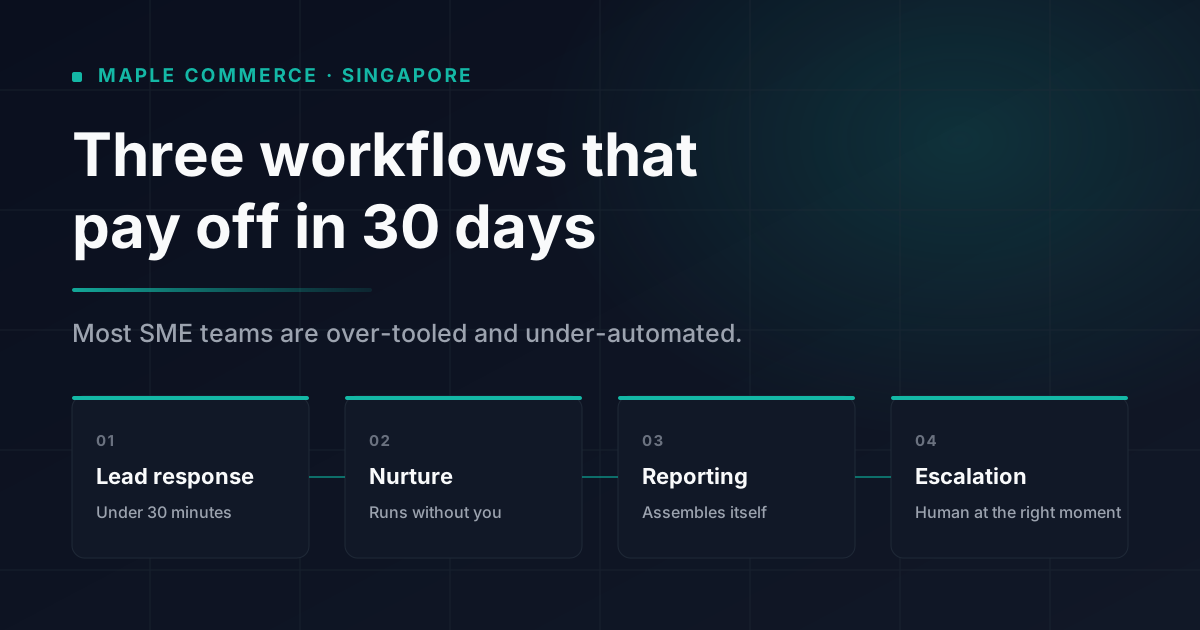
Most Singapore SME marketing teams are over-tooled and under-automated — the licences are paid for and the workflows were never built. Three workflows produce measurable savings inside 30 days, and lead response is almost always the first one.
The average Singapore SME marketing team has subscribed to between five and nine AI tools. The average Singapore SME marketing team has automated zero recurring workflows. There is a gap between buying AI tools and using AI to remove work.
This is the gap most teams I work with are stuck in. They have ChatGPT, Claude, a content calendar tool, an email platform, a CRM, and maybe Make or Zapier on the side. None of these tools talk to each other. Nothing repetitive has been removed from anyone’s diary. The team still does most of what they did 18 months ago, with the same number of people, and the same amount of after-hours work.
The fix is not more tools. The fix is automating three specific recurring jobs that already exist in the team’s day.
What does automation actually do?
AI marketing automation means three things, in increasing order of complexity:
- Doing repetitive work without human intervention. A campaign goes out at a scheduled time. A drip sequence triggers when someone downloads a guide. A weekly report compiles itself and lands in an inbox on Monday morning.
- Connecting tools that do not natively talk to each other. A form submission in your website CMS creates a lead in your CRM, tags the source, and notifies sales in Slack – without anyone touching a spreadsheet.
- Using AI to do parts of the work judgement was previously needed for. Drafting a personalised follow-up email based on lead context. Scoring inbound leads. Generating SEO meta descriptions from a content brief. Classifying inbound enquiries by topic before they hit a human inbox.
Most SME teams in Singapore can get the first two running in a fortnight. The third requires more design work but produces the biggest gains.
The mistake is trying to do all three at once. Sequence matters.
Which three workflows pay off in 30 days?
Across the SME engagements I run – usually two to six people in marketing, B2B services or B2B SaaS, revenue between SGD 1 million and SGD 10 million – three automations consistently pay back inside the first month.
1. Lead intake and routing
The job: a form gets submitted on your website. The lead lands in your CRM with the right tags, the right owner, the right context. The team is notified. Sales follows up within an hour during business hours, or first thing the next day outside them.
The manual version of this workflow eats two to four hours of someone’s week. Multiply across two team members and you are losing nearly a day of capacity to copy-paste work that does not require a human.
The automated version: Make or Zapier between the form, the CRM (HubSpot, Pipedrive, or whatever you use), Slack, and an enrichment tool. Apollo or Clearbit can append company information. A short Claude or ChatGPT call can summarise the enquiry in two lines for the sales rep’s attention. Total setup time: half a day for someone who has used Make before, full day for someone who has not.
Output: faster response times, cleaner CRM data, one less repetitive job in the team.
2. Weekly marketing reporting
The job: every Monday, someone pulls together last week’s marketing performance. Website traffic, top organic queries, top-performing content, paid spend, leads generated, pipeline contributed.
The manual version takes one to two hours a week. Three quarters of that work is copy-paste from GA4, Search Console, Meta Ads, Google Ads, and the CRM into a Google Sheet or a deck.
The automated version: a scheduled Make scenario or n8n workflow that hits the APIs of each source, pulls the numbers, and writes them into a structured Google Sheet or Notion page. A Claude call against the structured data writes a one-paragraph commentary. The result lands in Slack at 9am Monday.
You will still want a human eye on the commentary before it goes to the CEO. The point is that the human time goes from compiling data to interpreting data. The work shifts from clerical to strategic.
3. Content briefs and meta descriptions
The job: someone in the team writes the brief for a blog post, then later writes the title, meta description, social copy, and internal-link recommendations.
The manual version is fragmented across multiple tools and produces inconsistent output. Briefs miss key context. Meta descriptions are written under deadline and rarely optimised. Social copy gets thrown together at the last minute.
The automated version: a structured prompt template that takes the post’s target query, the writer’s notes, and three reference URLs, and produces a content brief, three title options, an optimised meta description, social copy variants, and an internal-link list – all in one pass. Claude or ChatGPT handles this well with a properly designed prompt. The output is not final – it needs a human edit – but it removes 70% of the structural work.
This is one of the workflows I rebuild for almost every client engagement, and it is one of the places I apply the FRAME prompt-building methodology to keep the output consistent across writers.
Which tools make this work?
For most SME teams in Singapore, the working stack for these three automations is:
| Job | Tool | Monthly cost (SGD) |
|---|---|---|
| Automation orchestration | Make (formerly Integromat) | 30 – 120 |
| AI inference | Claude (Pro or Team) or ChatGPT Plus | 30 – 60 per seat |
| Data store | Google Sheets or Notion | 0 – 20 per seat |
| Enrichment | Apollo or Clearbit | 60 – 200 |
| Notification | Slack (already in most teams) | – |
Total monthly tooling cost for a team of three running all three automations: under SGD 600. The time savings, conservatively, are 8 to 15 hours a week across the team. At even SGD 30 an hour fully-loaded, that is SGD 1,000 to SGD 1,800 a month back into strategic work.
The payback is not the hours alone – it is what the team does with the recovered capacity. The teams I have seen do this well use the freed-up time on the work that automation cannot do: positioning, customer interviews, partnership development, content strategy.
What gets in the way?
Three recurring obstacles I see when I run these automation engagements with SMEs in Singapore:
Nobody on the team has done this before. Make and Zapier are friendly tools, but the first scenario takes longer to build than the second, and the second takes longer than the tenth. If the marketing team has nobody with even introductory automation experience, the workflows will sit half-built. The fix is either to train someone on the team (a one-day workshop is usually enough to get over the starting bump) or to bring in someone external to build the first three workflows and document them.
The CRM is a mess. Automation reveals data hygiene problems that were hidden when everything was manual. If your CRM has three fields for “industry”, contact records are partly populated, and tags are inconsistent, the automation will replicate the mess at speed. Spend a week cleaning the CRM before you build the first workflow.
Nobody owns it. Marketing automation often ends up “owned” by whoever set it up, which becomes a single point of failure. A workflow that runs every Monday morning needs a documented owner, an escalation path when it breaks, and a quarterly review. Set those up at the same time as the workflow.
What does a workable 30-day plan look like?
For an SME marketing team starting from zero automation:
| Week | Focus | Deliverable |
|---|---|---|
| 1 | Audit existing tools, clean CRM data, pick the first workflow | Tool stack list and CRM cleanup |
| 2 | Build the lead-intake-and-routing automation | Live workflow, owner assigned |
| 3 | Build the weekly reporting automation | Live workflow, first Monday report sent |
| 4 | Build the content-brief prompt template, train the writers on it | Documented prompt and three test outputs |
By the end of week four, the team has three running automations, a cleaner CRM, and someone who knows how to build the next one. That is the foundation. After that, the work compounds.
What does automation not solve?
Automation is not strategy. If your marketing function is not generating leads, automating the bad workflow makes the same bad outcome happen faster. Diagnose the strategy first, then automate the execution.
I have seen teams excited about a beautiful Make scenario that automates the delivery of content nobody wants to read to a list nobody validated. The automation worked. The marketing did not.
Treat automation as an amplifier. If the underlying work is sound, automation multiplies it. If the underlying work is broken, automation multiplies the breakage.
What should you test this week?
Pick one recurring marketing job that takes someone in your team more than 30 minutes a week. Open Make or Zapier. Map out the steps. Identify which steps require human judgement and which do not. Build the non-judgement steps as an automation and leave the judgement steps for the human.
Most teams find one such automation in under an hour. Building it takes a few hours more. The time payback is permanent.
If you want a structured audit of where automation would pay back in your team, reach out or read more about Maple Commerce’s AI marketing consulting work. For corporate teams that want their whole marketing function trained on AI workflows, see the corporate training engagement model.
For the full three-layer picture and SGD costs, see marketing automation in Singapore; for where it sits in the funnel, the pillar on AI marketing in Singapore.