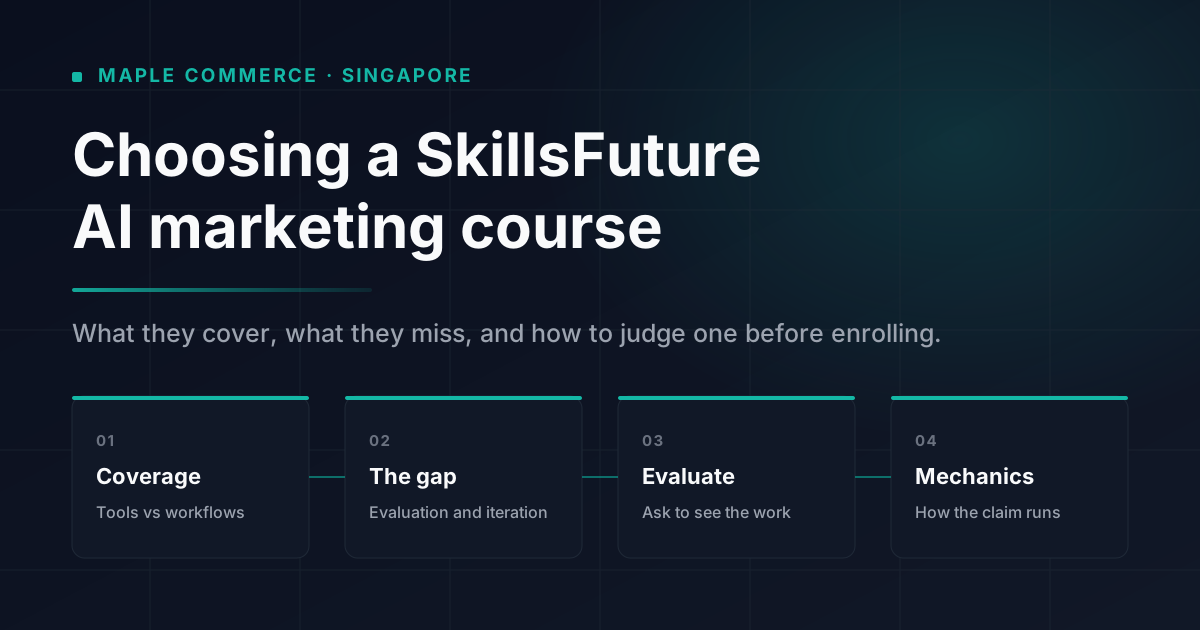
Most SkillsFuture AI marketing courses cover tools well and workflows poorly, and funding eligibility is not a quality signal. The question worth asking before you enrol is whether you will leave able to rebuild one specific workflow in your own tools.
Singapore’s SkillsFuture programme funds a lot of courses. Not all of them are worth your time. If you are looking specifically at SkillsFuture AI marketing courses, the landscape has changed significantly in the past 12 months — and a lot of what was being taught in 2023 is already obsolete.
This is a practitioner’s take on what to look for, what to avoid, and how to assess whether a course will actually shift how you work.
What do SkillsFuture AI marketing courses actually cover?
Most SkillsFuture AI marketing courses in Singapore fall into three buckets.
The first is AI writing tools — using ChatGPT, Claude, or similar tools to generate copy, captions, and email drafts. These courses are useful as a starting point but they train you on the output layer, not the thinking layer. You learn how to prompt; you do not learn how to build a system.
The second bucket is marketing analytics with AI — connecting Google Analytics, Meta Ads, or CRM data to dashboards, then layering in AI-assisted interpretation. These are more durable skills. Understanding how AI surfaces patterns in campaign data is useful regardless of which tools you are using in three years.
The third bucket is AI marketing automation — building workflows that connect tools like Make.com, Zapier, or n8n to automate lead nurturing, social posting, and reporting. This is where the real leverage sits for small and mid-sized teams.
What do most courses miss?
The gap I see consistently is the absence of strategy. A course can teach you to write prompts or configure a workflow. It rarely teaches you to diagnose which part of your funnel is actually broken, or whether automation will help or just move the problem downstream faster.
SkillsFuture AI marketing courses are assessed on completion and sometimes a project submission. They are not assessed on whether you can apply the skills to a real marketing problem three months later. That is a structural limitation, not a criticism of any specific provider.
The other gap is localisation. A lot of course content is written for US or UK markets. Singapore buyer behaviour, platform preferences (LinkedIn skews heavily professional here; Facebook still performs for certain B2C segments), and regulatory context around data and advertising are different enough that generic content misleads more than it helps.
How do you evaluate a course before enrolling?
Before you commit your SkillsFuture credit to an AI marketing course, ask these questions.
Is the curriculum updated in the last six months? AI tools move fast. A course last reviewed in early 2024 is likely teaching tool configurations that have already changed. Ask the provider directly.
Does the trainer use these tools in live client work? There is a meaningful difference between someone who teaches AI marketing and someone who does AI marketing for clients. Ask for case studies or examples from Singapore-based campaigns.
What is the output? The best courses end with something you can use immediately — a working automation, a content brief template, an analytics dashboard. Not just a certificate.
Is there community or follow-on support? AI marketing is not a one-time skill acquisition. The tools evolve. A course that leaves you with a peer group or a way to ask questions after the training ends is worth significantly more than one that does not.
How do the SkillsFuture Credit mechanics work?
For those unfamiliar: Singapore residents aged 25 and above have a SkillsFuture Credit balance they can apply to approved courses. The base credit is currently SGD 500, with top-ups for mid-career professionals and those in specific sectors.
To use SkillsFuture credit for an AI marketing course, the course must be listed on the MySkillsFuture portal and be SSG-approved. Not every course marketed as “SkillsFuture-claimable” is actually on the portal — verify before you book.
The credit does not expire, so there is no urgency to spend it on the wrong course. Take the time to compare two or three options.
What else is worth knowing?
The highest-leverage AI marketing skill right now is not prompt writing or tool configuration. It is being able to design a system — knowing which data matters, which processes can be automated versus which require human judgment, and how to measure whether any of it is working.
That is harder to teach in a two-day course than “how to use ChatGPT for content”. Which is probably why most courses do not try.
If you are evaluating AI marketing training for your team or for yourself, I am happy to talk through what would actually be relevant for your situation. The contact page is here — no pitch, just a conversation.
For the funding mechanics in full, see the SkillsFuture AI marketing training guide; for team-level programmes, the corporate AI training guide.