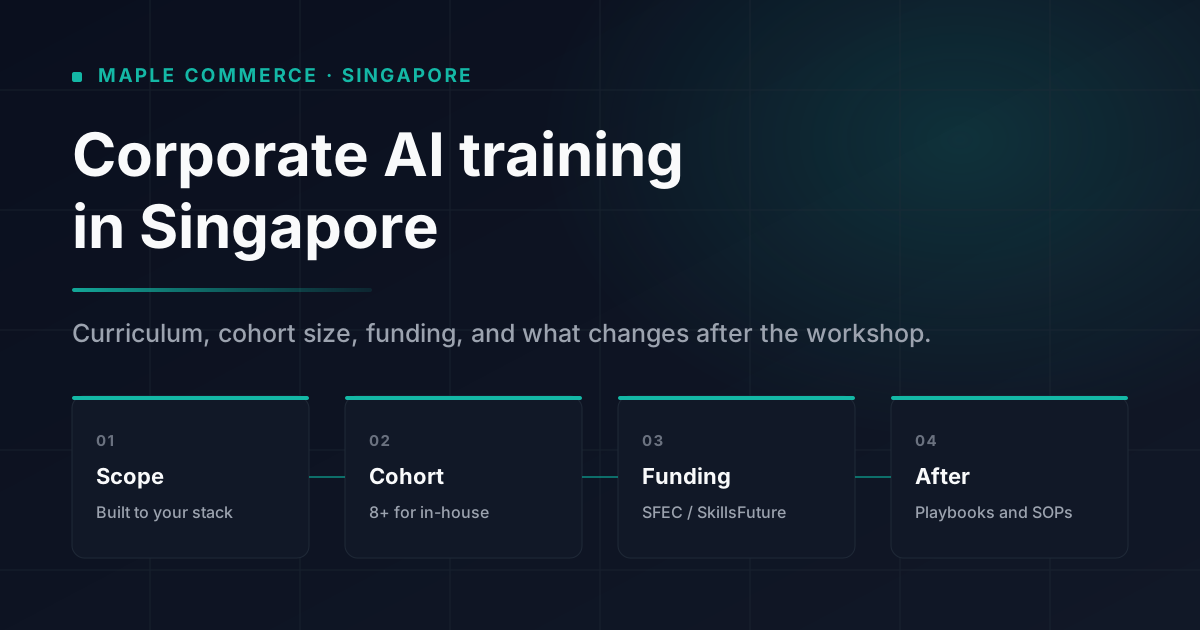
Corporate AI training works when it is scoped around one specific workflow your team already owns, and fails when it is booked as a generic tool tour for everyone. Funding — SkillsFuture for individuals, SFEC for company cohorts — changes the maths, but not that rule.
Most corporate AI training in Singapore fails before the first session starts. Not because the trainer is bad, but because the company booked a generic “Intro to ChatGPT” workshop when what it actually needed was three people who can rebuild one specific workflow. If you’re evaluating corporate AI training for your Singapore team, this guide covers what to buy, what to skip, and how to fund it.
Why doesn’t most corporate AI training stick?
The standard failure pattern looks like this: HR books a half-day seminar, forty people attend, everyone nods, and six weeks later nobody has changed how they work. The training was an event, not a capability.
AI skills decay fast when they aren’t applied to real work. A marketer who learns prompt techniques on toy examples will not transfer that to campaign briefs on Monday. The teams that get results train on their own data, their own tools, and their own processes — invoices they actually issue, support tickets they actually answer, reports they actually write.
So the first filter when assessing any corporate AI training in Singapore: does the provider ask for your real workflows before quoting? If the curriculum is fixed before they’ve seen how your team works, you’re buying theatre.
Who should you train first?
The instinct is to train the whole company at once. Resist it.
A better sequence:
- Pick one team with a measurable bottleneck. Marketing ops, finance close, customer support — somewhere the before/after can be counted in hours saved or output shipped.
- Train a small group deeply rather than everyone shallowly. Two or three motivated people who can build and maintain an AI-assisted workflow beat forty people with a certificate.
- Ship one workflow change within two weeks of the training. If the engagement doesn’t include this, the knowledge evaporates.
- Let the first team demo to the rest. Internal proof travels much further than an external trainer’s slides.
This is the opposite of how most training budgets get spent, which is exactly why most training budgets get wasted.
How do you fund corporate AI training in Singapore?
Individuals know SkillsFuture Credit, but companies have their own routes, and they’re underused:
- SkillsFuture Enterprise Credit (SFEC) — eligible employers get credit to offset out-of-pocket costs on supported workforce transformation programmes, including AI courses. The source of record is the SFEC page; Enterprise Singapore’s SFEC FAQ is the companion.
- Course fee subsidies for SME-sponsored employees — Singaporean and PR staff sponsored by SMEs typically attract significantly higher subsidy rates on WSQ-aligned and approved courses. Browse eligible listings on MySkillsFuture; individuals claim SkillsFuture Credit separately.
- Enterprise Development Grant (EDG) — relevant when training is part of a broader transformation project (for example, redesigning a marketing or operations process around automation, with training as one component). Official page: Enterprise Singapore’s EDG. Applications go through the Business Grants Portal.
Two practical notes. First, the subsidy follows the course’s approval status, so ask any provider directly: “Is this claimable, and under which scheme?” A precise answer is a good signal; a vague one is not. Second, don’t let funding drive the curriculum. A subsidised course that doesn’t change how your team works is more expensive than a paid one that does — it just hides the cost in payroll hours.
What should the curriculum cover in 2026?
Tool tutorials age in months. Capabilities compound. A corporate AI training programme worth paying for in Singapore right now covers:
- Workflow decomposition — breaking a real job into steps an AI can draft, a human should verify, or neither. This is the core skill; everything else hangs off it.
- Prompting as specification, not magic words — teaching staff to write instructions the way they’d brief a junior hire: context, constraints, examples, acceptance criteria.
- Verification habits — where models fail (numbers, names, recency, confident nonsense) and how to build checking into the workflow rather than trusting outputs.
- One automation tool in depth — whether that’s Make, n8n, or native platform features, the team should leave having connected an AI step to a real system they use.
- Data discipline — what can and cannot be pasted into which tools, aligned with PDPA obligations and your own client confidentiality terms. For organisations deploying AI more broadly, IMDA and PDPC’s Model AI Governance Framework is the voluntary national reference — human involvement, data accountability, and stakeholder communication rather than a marketing-tool tour.
Notice what’s absent: model architecture, AI history, speculative futures. Interesting, but they don’t change Monday.
How do you measure whether it worked?
Decide the metric before the training, not after. Useful ones are boring:
- Hours per week reclaimed on the targeted workflow
- Turnaround time on a specific deliverable (first-draft reports, campaign briefs, support replies)
- Number of AI-assisted workflows in production 60 days later
- How many trained staff still use the workflow daily after a quarter
If a provider can’t tell you how they’d measure transfer into real work, the engagement is a seminar with better branding.
Should you build the training or buy it?
Some Singapore companies are hiring AI leads instead of buying training. For most SMEs that’s premature — you don’t yet know what the role should own. A more capital-efficient sequence: train a small internal group, ship two or three workflow changes, and only then decide whether the volume of opportunity justifies a dedicated hire. Training first also means that when you do hire, the team can brief the role properly instead of outsourcing their understanding to it.
How do you choose a provider?
- Will you look at our actual workflows before proposing a curriculum?
- What will we have shipped by the end of the engagement?
- Which funding scheme applies, and what’s our net cost?
- How do you handle our data and PDPA compliance during exercises?
- What does follow-up look like 30 and 60 days after the last session?
Strong answers to all five are rarer than they should be. It also helps to know which of the four kinds of corporate AI trainer you are talking to, because funding and customisation pull in opposite directions for three of them; the comparison is on the corporate AI trainer in Singapore page.
Corporate AI training in Singapore is worth the budget when it’s scoped around real work, funded intelligently, and measured on shipped workflow changes — and a waste of a perfectly good afternoon when it isn’t. If you’re mapping out what AI capability-building should look like for your team, I’m happy to compare notes — details are on the services page, or get in touch.
On the funding mechanics specifically, see the SkillsFuture AI marketing training guide. For where training fits alongside the rest of a programme, start with the pillar on AI marketing in Singapore.