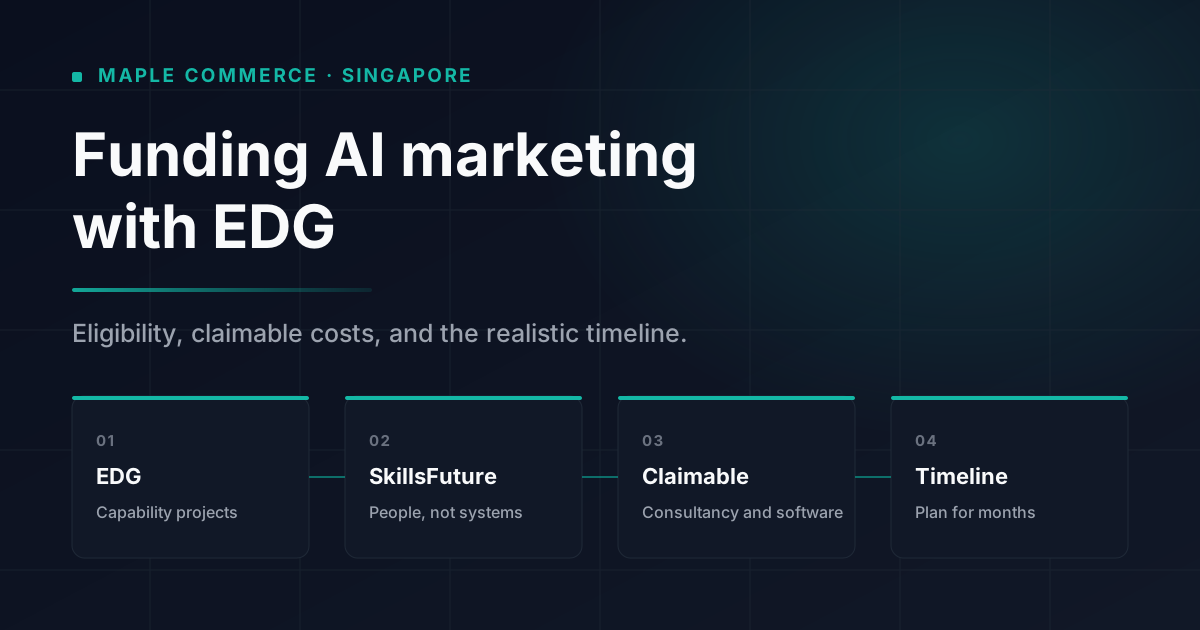
EDG funds capability projects and SkillsFuture funds people — most AI marketing adoption needs both, applied to different parts of the scope. The single rule that decides most applications: approval has to come before the work starts.
If you run a Singapore SME and you’ve been circling the idea of bringing AI into your marketing, there’s a question you’ve probably asked: who’s going to pay for this?
I hear it every week. The interest is there. The budget isn’t — or at least, the budget hasn’t been justified yet. That’s where Singapore’s funding ecosystem comes in, and specifically the Enterprise Development Grant (EDG). Most business owners I speak to have heard of SkillsFuture for individual courses, but far fewer understand how the EDG works for company-level transformation projects, including AI marketing implementation.
This guide breaks it down from the ground up. No government jargon. Just what I’ve learned helping Singapore SMEs navigate these grants in practice.
What Is the EDG — and Why Does It Matter for AI Marketing?
The Enterprise Development Grant is administered by Enterprise Singapore (EnterpriseSG). It funds up to 50% of qualifying project costs for Singapore SMEs undertaking projects in three categories: Core Capabilities, Innovation and Productivity, and Market Access.
AI marketing projects typically fall under Innovation and Productivity — specifically, projects that help businesses adopt technology to improve efficiency or develop new capabilities. If you’re implementing AI-driven marketing automation for your business, that’s a qualifying use case.
The key numbers:
- Up to 50% funding support for qualifying costs (as of 2026 — the rate has fluctuated; it was 70-80% during COVID-era enhanced support, but has since normalised)
- Maximum project duration: typically 12–18 months
- Minimum project value: most consultants recommend projects above S$30,000 in total qualifying costs to make the application worthwhile
Who Is Eligible?
To qualify for the EDG, your company must:
- Be registered and operating in Singapore
- Have a minimum of 30% local shareholding
- Be in a financially viable position to start and complete the project
- Not be in default of any existing EnterpriseSG grant
For the AI marketing angle specifically, you’ll need to demonstrate that the project involves adoption of new technology or processes — not just hiring a consultant to run your existing Facebook ads. The distinction matters. EnterpriseSG wants to see that you’re building new capability, not outsourcing existing work.
SkillsFuture vs EDG: What’s the Difference?
This is where most people get confused, so let me draw the line clearly.
SkillsFuture funds individual learning. If you or your marketing team member wants to attend an AI marketing course — say, a SkillsFuture-accredited programme on AI tools for digital marketing — that’s SkillsFuture Credit territory. It covers training fees, typically up to the individual’s credit balance (most Singaporeans have S$500–S$1,000 available depending on age cohort and top-ups).
EDG funds company-level transformation. If you want to bring in a consultant to help your business implement AI marketing — set up automation workflows, build an AI-powered content system, redesign your marketing data infrastructure — that’s an EDG project.
The two can complement each other. You might use SkillsFuture to upskill your marketing coordinator through an AI marketing course, while simultaneously running an EDG project to implement the actual AI systems they’ll be managing. I’ve seen this combination work well for SMEs in the 10–50 staff range where the marketing function sits with one or two people.
What AI Marketing Costs Can You Claim Under EDG?
Based on what I’ve seen approved for clients and what EnterpriseSG’s guidelines outline, here’s what typically qualifies:
Claimable costs:
- External consultant fees for AI marketing strategy and implementation
- Technology setup and configuration (e.g., marketing automation platforms, AI content tools, analytics infrastructure)
- Process redesign — mapping your existing marketing workflows and redesigning them around AI capabilities
- Training-as-part-of-project — if training your team to operate the new systems is built into the project scope, those costs can be included
Generally not claimable:
- Software subscription fees (ongoing SaaS costs are operational, not project costs)
- Media spend (advertising budgets, content production for campaigns)
- Hardware purchases (unless directly and solely required for the project)
- Pre-existing or already-committed costs
The nuance is in the scoping. I’ve worked with SMEs where the line between “implementation project” and “ongoing operational tool” gets blurry — especially when you’re setting up an AI content system that will run indefinitely. The trick is to frame the project as having a clear start, a defined deliverable (e.g., “an operational AI marketing system with documented processes”), and a training component that transfers capability to your team.
How do you apply?
Here’s the application flow as I’ve walked clients through it:
Step 1: Assess Your Readiness
Before you apply, you need clarity on three things:
- What specific marketing problem are you solving with AI?
- What does the project look like (scope, timeline, deliverables)?
- Who is your project partner (consultant or vendor)?
EnterpriseSG expects a detailed project proposal. Vague applications get rejected.
Step 2: Get a Quotation from Your Project Partner
You’ll need at least one quotation from your technology or consulting partner. For AI marketing projects, this partner should be able to demonstrate relevant capability — not just general IT experience, but specific AI marketing implementation track record.
Step 3: Submit via the Business Grants Portal (BGP)
All EDG applications go through the Business Grants Portal. You’ll need:
- Your CorpPass login
- Financial statements (last 2 years)
- The project proposal and quotation
- ACRA business profile
Processing time: typically 6–8 weeks, though I’ve seen it stretch to 12 weeks for complex projects.
Step 4: Project Execution and Claims
Once approved, you execute the project and submit claims on a reimbursement basis. Keep meticulous documentation — EnterpriseSG can audit claims, and I’ve seen sloppy record-keeping cause claim rejections.
What mistakes do applicants make?
1. Scoping the project too broadly. “We want to do AI marketing” is not a project. “Implement an AI-powered lead scoring and email nurture system integrated with our CRM” is. Be specific.
2. Choosing the wrong project partner. Your existing IT vendor who maintains your email server is probably not the right partner for an AI marketing implementation. Look for partners with actual marketing domain expertise and AI implementation experience.
3. Forgetting the training component. EnterpriseSG wants to see sustainable capability transfer. If the project ends and your team can’t operate the systems independently, that’s a red flag. Build training and documentation into your project scope from the start.
4. Not budgeting for the co-payment. Even at 50% funding, you’re paying the other half. For a S$60,000 project, that’s S$30,000 out of pocket. Make sure the ROI math works before you apply.
What is the realistic timeline?
If you’re starting from scratch today, here’s a realistic timeline:
- Weeks 1–4: Scoping, partner selection, application preparation
- Weeks 5–12: Application processing (6–8 weeks typical)
- Months 4–10: Project execution (AI marketing system implementation, team training)
- Months 10–12: Documentation, handover, final claims
From first conversation to operational AI marketing system: roughly 8–12 months. That’s the honest number. Anyone telling you it’s faster is either cutting corners or hasn’t done it with Singapore government grant compliance in mind.
Is It Worth It?
For the right SME, absolutely. The EDG effectively halves the cost of a transformation project that might otherwise be hard to justify on a tight marketing budget. I’ve seen 15-person companies build AI marketing capabilities that compete with businesses five times their size — and the EDG made the initial investment palatable.
But the grant itself doesn’t guarantee success. The implementation quality matters. The team buy-in matters. The strategic clarity on why you’re adopting AI marketing — not just that you should — matters more than the funding.
If you’re considering an EDG-funded AI marketing project and want to understand what’s realistic for your business, I’m happy to have that conversation. Get in touch to discuss your AI marketing project — no obligation, just an honest assessment of whether the grant makes sense for your situation.
Ivan Wong is the founder of Maple Commerce, a Singapore-based AI marketing consultancy. The marketing for this site — including the AI-assisted content strategy and semantic SEO architecture — runs on the same autonomous stack he builds for clients. Follow along on LinkedIn for weekly practitioner insights.
For the training side specifically, see the SkillsFuture AI marketing training guide and the corporate AI training guide.