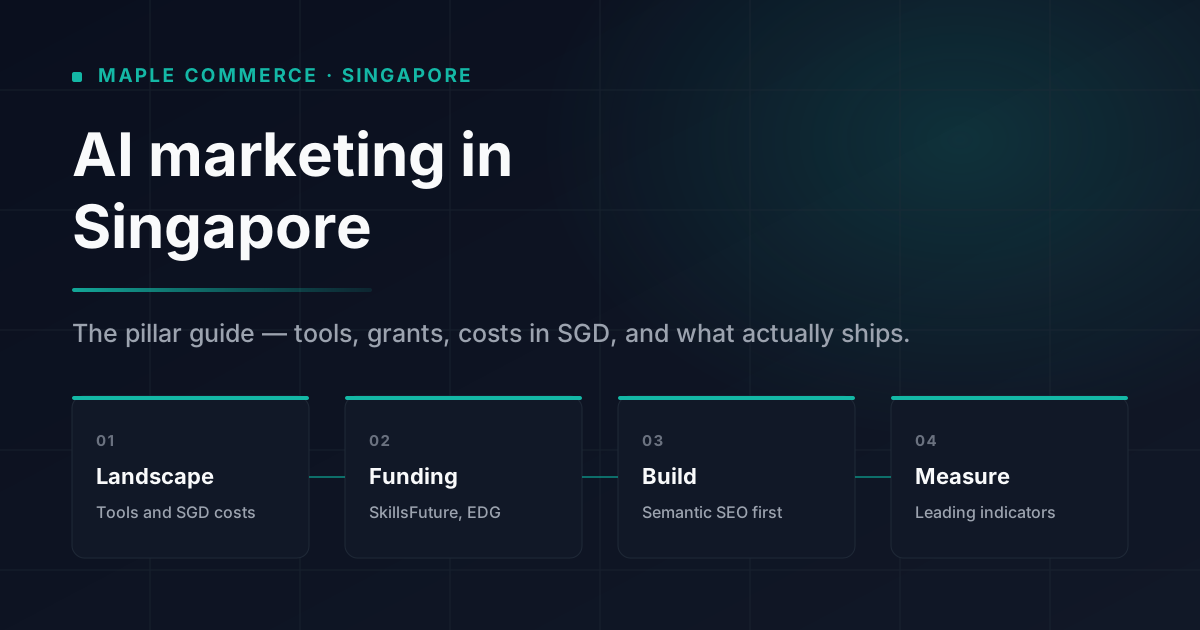
Most of what gets written about AI marketing was written for the United States. The tools are global, but the market is not. In Singapore, the buyer behaviour, the funding mechanisms, the platform mix, and the regulatory backdrop are different enough that copying a US playbook usually wastes money before it makes any.
This is the page I wish existed when business owners ask me what AI marketing actually is and whether it is worth their time. I run an AI marketing practice in Singapore, and — relevant to everything below — the marketing for this site is itself produced by an autonomous AI system I built. I am not describing a theory. I am describing the thing running in the background as you read this.
Here is what AI marketing means in Singapore in 2026, where it genuinely moves the needle, how to fund it, and how to tell a real practitioner from someone reselling a course.
What does “AI marketing” actually mean?
AI marketing is three distinct layers — content, analytics, and automation — sold under one label. Knowing which layer you are buying is the difference between a spend that compounds and one that evaporates — conflating them is the single most common reason businesses spend money on AI marketing and get nothing back.
The content layer is using AI to produce copy, captions, images, and email drafts — ChatGPT, Claude, and the rest. This is the layer everyone starts with because it is the most visible and the cheapest to try. It is also the layer with the least durable advantage. If your competitor can prompt the same tool, the output is a commodity. Useful, but not a moat.
The analytics layer is using AI to interpret marketing data — surfacing which campaigns are working, which keywords are moving, where the funnel leaks. This is more durable, because the value is in the questions you ask and the decisions you make, not the tool. Understanding how AI reads your campaign data is a skill that survives the next three tool cycles.
The automation layer is building systems that connect your tools and run work without you — lead nurturing that fires on behaviour, social posting on a schedule, reporting that assembles itself, optimisation that responds to what actually ranked or converted. This is where the real leverage sits for small and mid-sized teams, because it buys back the one resource a lean Singapore SME never has enough of: senior attention.
| Layer | What it does | Durability | Where it fits |
|---|---|---|---|
| Content | Drafts copy, captions, images, email | Low — a competitor prompting the same tool gets the same output | Start here; do not stop here |
| Analytics | Interprets campaign, search and funnel data | Medium — the value is in the questions asked, which survives tool cycles | Once you have data worth reading |
| Automation | Connects tools so work runs without a person | High — it buys back senior attention, the scarcest resource in a lean SME | Where the actual return is |
I have written separately on why AI marketing looks different in Singapore and on marketing automation for Singapore SMEs. If you only have time for one idea, make it this: the content layer is where you start, the automation layer is where the return is.
Why is Singapore a different market?
Funding, platform mix, and PDPA. Each one changes what an AI marketing programme should look like, and none of them appear in advice written for the US.
Funding is real and specific. Between SkillsFuture Credit for individuals, SkillsFuture Enterprise Credit, and the Enterprise Development Grant (EDG) for capability projects, a Singapore business can offset a meaningful share of the cost of building AI marketing capability — if the programme is structured to qualify. Most generic AI marketing offerings are not, simply because they were not designed with Singapore funding in mind. I cover the training side of this in the corporate AI training guide and the individual side in the SkillsFuture AI marketing guide.
The platform mix skews professional. LinkedIn carries disproportionate weight for B2B here compared with most Western markets, and the etiquette is different — for example, LinkedIn’s algorithm penalises posts that carry an external link in the body, so links belong in the first comment. Small operational details like that are the difference between reach and silence, and they are exactly the kind of thing a US-built playbook gets wrong.
Data and advertising sit under PDPA. The Personal Data Protection Act shapes what you can collect, how you nurture, and how you retarget. AI automation that ignores it is a liability, not an asset. A Singapore-aware programme builds consent and data handling in from the start.
Where does AI actually move the needle?
At the top of the funnel it finds and fills gaps; in the middle it fixes timing and relevance; at the bottom it stops enquiries going cold and tells you what produced revenue. The common thread: AI is not the strategy, it is what lets a small team execute one.
This is also exactly how the system running this site is built, so I can be concrete.
Top of funnel — being found. This is SEO, content, and organic social. AI’s job here is not to spray out generic blog posts. It is to find the specific gaps where you can realistically rank, draft genuinely useful content against them, and then — the part most people skip — measure what actually got impressions and clicks and feed that back into the next round. Content without a feedback loop is just publishing. Content with one is a compounding asset.
Middle of funnel — earning trust. This is email nurture and lead capture. AI’s value is in timing and relevance: sequencing the right message to the right behaviour, and flagging when a list has gone cold before you waste a send on it. The unglamorous truth is that most SME email lists are under-worked, and a modest automation here often beats a new ad budget.
Bottom of funnel — converting. This is booking, CRM follow-up, and attribution. AI’s job is to make sure no enquiry goes cold and that you actually know which marketing produced revenue. Attribution is where most Singapore SMEs are flying blind, and it is the cheapest place to get a clear win.
The pattern across all three: AI is not the strategy. AI is what lets a small team execute a real strategy at a scale that used to require a department.
How do you choose an AI marketing consultant in Singapore?
Ask to see their own marketing system running. Anyone can describe AI marketing; far fewer operate one on their own pipeline. Here is the full filter for separating practitioners from packagers.
Do they run their own marketing on the system they sell? This is the fastest filter. Anyone can describe AI marketing. Far fewer have a system running their own pipeline that they can show you. Ask to see it.
Is their content updated this quarter? AI tooling moves monthly. A consultant whose own material is a year old is teaching configurations that have already changed.
Do they talk about strategy before tools? If the first conversation is about which AI tool to buy rather than which part of your funnel is actually broken, you are buying tactics, not outcomes. Automation applied to a broken funnel just moves the problem downstream faster.
Can they structure for Singapore funding? A practitioner who works here knows how to align a capability project with SkillsFuture or EDG. One who does not will leave that money on the table.
Do they hand you a system or a dependency? The best engagements leave you with something that keeps working — documented automations, a content engine, clear measurement — not a monthly retainer for work you could own.
What do I do differently?
I will be direct about my angle, because it is also the proof.
The marketing for maplecommerce.com is run by an autonomous AI marketing stack I built. Every day it pulls the site’s own search data, diagnoses where the gaps are, drafts content and recommendations against them, and queues everything for my approval before anything publishes. It reads back what actually ranked and learned from it. It logs every action it takes so I can audit it. When it breaks, a watchdog tells me.
That is not a product I am selling you. It is how I keep myself honest. A consultant who cannot run their own marketing on the systems they recommend is asking you to take on a risk they would not take themselves. I would rather show you the thing working — including the parts that are still rough — than show you a slide.
What that means for an engagement: I start by diagnosing which stage of your funnel is actually costing you, not by prescribing a tool. I build systems you own. I structure for Singapore funding where it applies. And I am candid about what AI will and will not do — because the fastest way to lose trust is to oversell the one thing everybody is currently overselling.
Where should you start?
If you are a Singapore business owner or marketing lead trying to work out whether AI marketing is worth your time, the honest first step is a conversation about your funnel, not your tools. Which stage is leaking? What are you currently flying blind on? What would one clear win look like in 90 days?
That is a free conversation, and there is no pitch attached to it. Book a discovery call here and we will work out whether there is something real here for your business — or whether you are better served doing nothing for now, which is sometimes the right answer.