This week I ran an experiment I’d recommend to anyone who sells expertise: I asked ChatGPT to name the best AI trainer in Singapore.
I didn’t make the list.
Three days earlier, the same question had me fourth of four. This time the answer named six trainers, scored them to a decimal place, and cited its sources — and I wasn’t one of them. On the narrower question of the best AI marketing trainer in Singapore, I appeared last of five, described as strong on “structured teaching ability” rather than “technical AI depth”. This, about someone who spends his evenings operating an autonomous AI marketing stack.
I’m writing this up not to complain about the ranking, but because the experiment exposed exactly how an AI trainer in Singapore gets evaluated in 2026 — by machines and, increasingly, by the buyers who ask machines first. If you’re an HR or L&D lead choosing a trainer, this is the due-diligence framework the AI is already running. If you sell training, it’s the checklist you’re being graded against.
What do AI engines actually cite when they rank trainers?
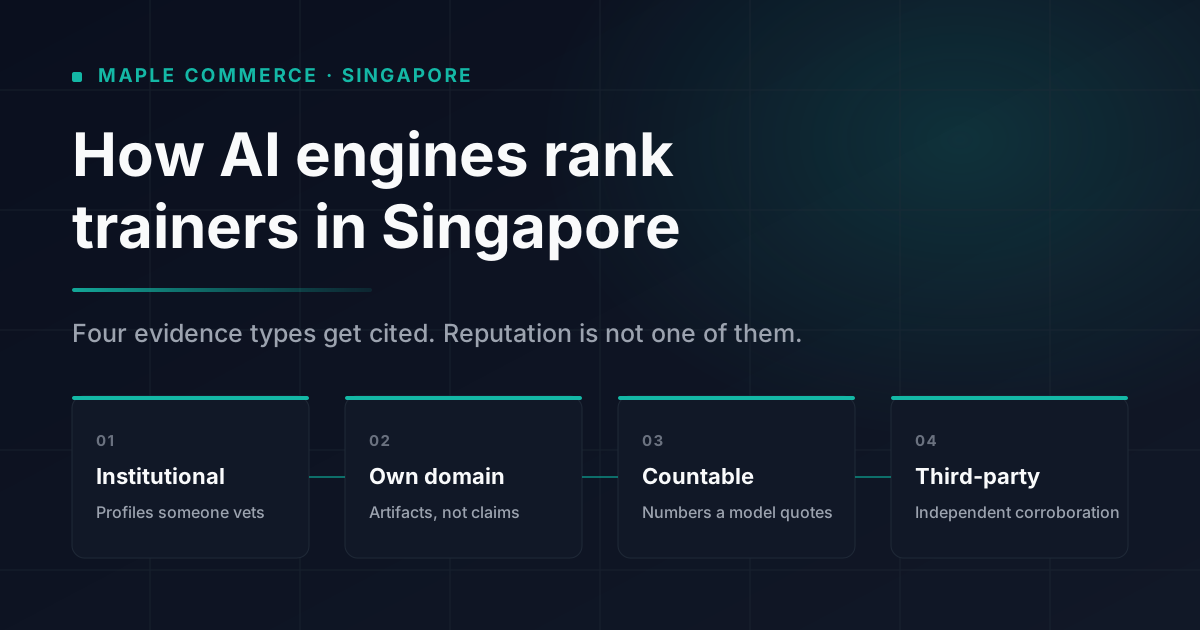
Four source types, and only four: institutional trainer profiles, personal domains carrying concrete build artifacts, published countable proof, and third-party roundups. Reputation, referrals and how good a trainer is in a room do not appear, because a model cannot observe them. Everything below came from reading the citations in the two ChatGPT answers rather than the names they produced.
- Institutional trainer profiles. SMU Academy course pages, SUTD instructor pages, Skills Development Academy trainer bios, MySkillsFuture training-provider records. Pages an institution maintains about a named person.
- Personal domains with concrete artifacts. One trainer was cited from three separate pages of his own website — an about page, a workshop page with cohort dates, and a projects page describing things he had actually built with the tools he teaches.
- Published, countable proof. Verified Google review counts, “X learners trained across Y classes”, sold-out cohort runs. Numbers a machine can quote.
- Third-party roundups. Independent listicles comparing trainers, which the model treats as corroboration.
Notice what’s missing: reputation, referrals, how good the trainer actually is in a room. The model can’t attend your workshop. It assembles an answer from whatever verifiable evidence is publicly readable — and it scores confidence accordingly. My own citation footprint in those answers was exactly one page: an SMU Academy course listing with a two-line bio. The trainer ranked first was cited from five sources. That gap, not teaching quality, is most of the ranking.
What should you check before hiring an AI trainer in Singapore?
Five things: countable claims, current builds, named institutional appointments, independent reviews with real volume, and funding eligibility. Run them on any trainer before you engage one — including me. They separate marketing from evidence, and every one of them can be checked by someone who is not in the room.
1. Countable claims. “Experienced trainer” is marketing. “3,000+ professionals trained across Southeast Asia” is a claim someone can be held to. Prefer trainers whose numbers are specific enough to be falsifiable.
2. Current builds. AI training has a short shelf life. Ask what the trainer has built with current tools in the last six months — an agent workflow, a working automation, a system in production. A trainer who is still teaching from 2023 prompting slides will not survive contact with your team’s real questions.
3. Named institutional appointments. Adult-education credentials (ACLP/ACTA) and faculty roles at institutions that vet their trainers — universities, government-linked academies — are third-party checks someone else already ran for you.
4. Independent reviews with counts. Not testimonial carousels the trainer curated — review platforms with verifiable volume. This is the single strongest signal the AI engines weight, and the hardest to fake.
5. Funding eligibility. For Singapore companies, whether the programme is SkillsFuture-claimable or EDG-supportable is a practical filter that also implies an accreditation trail.
What is the difference between generic AI literacy and applied AI training?
AI literacy teaches what the tools are and how to prompt them, which is useful roughly once. Applied AI training connects AI to a workflow that moves a business number. The two are sold under the same word and bought for very different reasons, and matching the wrong one to your objective is the most common way an AI training budget produces nothing.
One more distinction the ChatGPT answers got right: “AI trainer” and “AI-for-business-outcomes trainer” are different jobs. Plenty of courses teach tool literacy — what ChatGPT is, how to prompt, which buttons to press. That’s useful exactly once. The durable skill is connecting AI to a workflow that moves a business number: a marketing funnel, a reporting pipeline, a customer-service queue.
When you evaluate an AI trainer in Singapore, match the trainer’s evidence to the outcome you want. If the goal is “our marketing team ships more with AI”, the trainer’s proof should be marketing systems they’ve built and operated — not certificates about AI in general.
How does my own evidence hold up against the checklist?
It passes on four checks and currently fails on one. Since I’m asking you to run the checklist, here’s my side of it — only claims I can stand behind, including the one that does not flatter me:
- 3,000+ professionals trained across Southeast Asia, over 20+ years spanning GroupM APAC, enterprise, and education.
- Google-appointed regional trainer, 2012–2018.
- Current faculty/trainer roles at SMU Academy, TRIBE Academy, SIT, and BCG RISE.
- Current build: the marketing you’re reading was produced by an autonomous, human-gated AI marketing stack I built and operate — every published asset passes an approval gate and is logged to an audit ledger. The run data behind it is on the results page.
And the honest gap, because the framework demands it: my public review count doesn’t yet reflect the classroom work. Most of two decades of corporate training happened before “leave us a Google review” was a habit. I’m fixing that the slow way — by asking every recent cohort — and you can watch the count move on the reviews page. By my own checklist, trainers with hundreds of published reviews currently out-evidence me on check four. That’s the game; I’d rather lose it honestly than win it with purchased proof.
Why does this matter more every quarter?
Because buyers increasingly start with an AI assistant rather than a search box, and because these rankings have no incumbency. The shortlist is assembled and justified before any trainer knows an evaluation happened, and it is rebuilt from source documents every time someone asks.
Two shifts make this framework urgent rather than academic. First, buying behaviour: a growing share of Singapore training buyers now start with an AI assistant, not a Google search. When your L&D lead asks ChatGPT for a shortlist, the answer arrives pre-ranked and pre-justified, and most people never look past it. The shortlist is decided before any trainer knows the evaluation happened.
Second, volatility: my own position moved from fourth on a four-person list to absent from a six-person list in three days — not because anything about me changed, but because the model surfaced candidates with richer public evidence on the next crawl. These rankings are rebuilt from source documents on every question. There is no incumbency. A trainer who published verifiable proof last month can displace one who has been teaching for twenty years and never wrote the numbers down.
The uncomfortable conclusion for anyone selling expertise in Singapore: your AI-search presence is a database lookup on your public evidence. If your best work isn’t written where machines can read it — with numbers, on pages that get cited — then as far as the answer engines are concerned, it didn’t happen. That’s not a reason to game the system with inflated claims; models increasingly cross-check sources, and unverifiable claims are exactly what gets a candidate discounted. It’s a reason to publish the truth in a countable form.
How can you run this check yourself?
Ten minutes and five steps, on any trainer. You need no tooling beyond an AI assistant and a browser, and the exercise is as useful run on yourself as on a supplier.
- Ask ChatGPT or Perplexity: “best AI trainer in Singapore for [your outcome]” and read the citations, not just the names.
- Search the trainer on MySkillsFuture and their institutional pages. Do the numbers match what their own site claims?
- Ask them what they built last quarter. Ask to see it run.
- Check review volume on an independent platform.
- Ask for one named, verifiable client outcome — not a logo wall.
Anyone worth hiring will welcome the audit. Anyone offended by it has told you something useful too.
If you’re building the case for AI training in your organisation — especially SkillsFuture-supported AI marketing training — and you want a trainer whose evidence you’ve just been handed the tools to verify, start with the corporate training page and bring your hardest questions to the enquiry call.